AI
Development
AI
Development
 Shopify
 Magento Open Source
 Adobe Commerce
 WordPress
 B2B Excellence


What Is Shopify Plus? Benefits, Pricing & How to Set Up a Store


Shopify Plus is Shopify’s enterprise plan for merchants who need advanced checkout customisation, B2B tools, automation, higher API limits and multi-store management.
You get additional tools to personalise your store, connect it with other business systems, automate repetitive processes and support high-volume sales.
In this guide: what Shopify Plus is, 2026 pricing, 10 differences vs standard Shopify, a 12-step setup process, and FAQs.
What Is Shopify?
With Shopify, you can easily build your own online store, keep track of sales, connect with your customers, and accept payments both online and offline.
Shopify gives businesses of different sizes access to tools for managing products, orders, customers, payments, marketing and sales channels from one central platform.
Whether you’re launching your first ecommerce business or managing an established online store, you can choose a Shopify plan based on the level of functionality and scale you need.
What Is Shopify Plus and Who Is It For?
Now that we’ve got Shopify down, let’s take it up a notch with Shopify Plus.
Shopify Plus is Shopify’s enterprise-level plan, designed for businesses that need more flexibility and control as their ecommerce operations become more complex.
Shopify Plus is a scalable SaaS platform that gives merchants access to advanced capabilities for areas such as:
- Checkout customisation
- Advanced B2B commerce
- Workflow automation
- Multi-store management
- Higher API capacity
- Headless commerce
- Custom commerce functionality
But here’s the important part: Shopify Plus is not simply about being a bigger business or reaching a specific revenue number.
A growing retailer may benefit from Shopify Plus because of complex B2B requirements, multiple international stores, advanced integrations or checkout customisation. On the other hand, a business with substantial sales but relatively simple requirements may find that Shopify Advanced is still a better fit.
Looking to set up your store on Shopify Plus but not sure where to start?
Our team is highly skilled in Shopify Plus.
How Much Does Shopify Plus Cost in 2026?
Shopify Plus pricing for UK businesses starts at £1,800 per month on a three-year term or £1,950 per month on a one-year term, billed monthly.
For more complex and higher-volume businesses, Shopify may apply a variable platform fee based on revenue and the business model. This means there is no single Shopify Plus price that applies to every merchant.
For comparison, Shopify Advanced costs £344 per month when billed monthly or £259 per month when billed annually in the UK.
Looking to set up your ecommerce store with Shopify Plus but not sure where to start?
If your business is considering Shopify Plus, the setup process involves more than simply choosing a theme and adding products.
A successful implementation may involve:
- Migrating products, customers and order data
- Integrating ERP, CRM or fulfilment systems
- Configuring B2B requirements
- Setting up multiple stores or markets
- Customising the storefront
- Extending checkout functionality
- Testing integrations and automations before launch
As a Shopify Partner agency, RVS Media helps businesses with custom Shopify development, integrations and ongoing support. For businesses moving to Shopify Plus, the focus should be on building the right technical and ecommerce setup from the beginning, rather than adding workarounds later.
What is the Difference Between Shopify and Shopify Plus?
The biggest difference between Shopify and Shopify Plus is the level of flexibility available for businesses with more complex ecommerce requirements.
Standard Shopify plans provide everything many businesses need to build and manage an ecommerce store. Shopify Plus adds enterprise capabilities for merchants who need greater control over areas such as checkout, B2B, automation, APIs and multi-store operations.
Some functionality that was once seen as exclusive to Plus is now available across other Shopify plans. Basic B2B features, for example, are no longer a Plus-only capability.
The difference is now more about advanced functionality and operational scale.
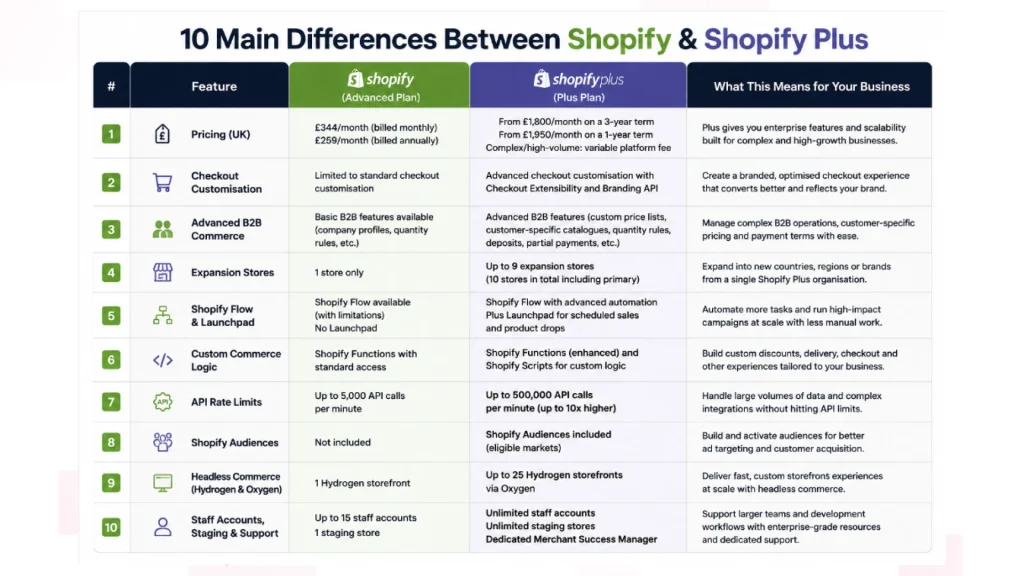
Shopify vs Shopify Plus: 10 Key Differences
1. Pricing
Shopify Advanced and Shopify Plus now have a clearer published price gap.
In the UK, Shopify Advanced costs £344 per month on monthly billing or £259 per month when billed annually.
Shopify Plus starts at £1,800 per month on a three-year term or £1,950 per month on a one-year term.
For higher-volume or more complex businesses, Shopify may apply a variable platform fee based on revenue and the business model, rather than a standard flat subscription price.
2. Checkout Customisation
Shopify Plus gives merchants greater flexibility to customise their checkout experience.
Using Shopify’s current checkout extensibility tools and Branding API, Plus merchants can customise the appearance and functionality of checkout within Shopify’s supported framework.
This is particularly useful for businesses that need more than a standard checkout experience.
3. Advanced B2B Commerce
Basic B2B functionality is now available across Shopify plans, so simply selling to businesses does not automatically mean you need Shopify Plus.
Shopify Plus is designed for businesses with more advanced B2B requirements, including deeper catalogue management, customer-specific purchasing experiences, quantity rules and more complex payment arrangements such as deposits or partial payments where supported.
4. Expansion Stores
Shopify Plus merchants can operate up to nine expansion stores in addition to their primary store, giving them up to ten stores under the same organisation.
These stores can support international expansion, local currencies, languages or different customer groups, subject to Shopify’s eligibility requirements.
5. Shopify Flow and Launchpad
The Shopify Flow can help automate repetitive tasks and workflows across your business.
Shopify Plus also includes access to Launchpad, which allows merchants to schedule and manage major ecommerce events such as:
- Flash sales
- Product launches
- Limited-edition drops
- Inventory releases
This can make a significant difference for businesses that regularly run large promotional campaigns.
6. Custom Commerce Logic
Shopify Plus gives businesses access to additional options for creating custom commerce functionality.
Shopify Functions can be used to build custom logic for areas such as discounts and other supported commerce experiences.
For merchants using older Shopify Scripts, it is important to review how those customisations fit into Shopify’s current development approach.
7. Higher API Limits
Businesses running complex integrations often need to exchange large amounts of data between Shopify and other systems.
Shopify Plus offers significantly higher API capacity than standard plans, with Shopify advertising up to 500% higher API call limits for Plus (source: Shopify).
This can be valuable when connecting Shopify with systems such as ERP, CRM, warehouse management or custom applications.
8. Shopify Audiences
Eligible Shopify Plus merchants can use Shopify Audiences to support advertising and audience targeting.
For businesses investing heavily in paid acquisition, this can become another useful tool within the wider Shopify Plus ecosystem.
Availability can vary depending on the merchant’s location and advertising requirements.
9. Headless Commerce and Hydrogen
Shopify Plus supports more extensive headless commerce capabilities.
Merchants can build custom storefronts using Hydrogen and deploy them through Shopify’s Oxygen hosting infrastructure, with Plus supporting up to 25 Hydrogen storefronts.
This is useful for businesses that need a highly customised frontend while keeping Shopify at the centre of their ecommerce operations.
10. Staff, Staging and Enterprise Resources
Shopify Plus includes unlimited staff accounts and additional resources for businesses managing larger teams and more complex development workflows.
Shopify Plus merchants can also use staging environments to test changes before they reach customers.
This is particularly useful when multiple teams, Shopify developers or agencies are involved in managing the ecommerce operation.
Shopify vs. Shopify Plus: Which One is Right for Your Business?
So, which one should you choose?
The answer depends less on finding a magic revenue number and more on understanding how complex your ecommerce operation has become.
Shopify Advanced could be the right option if you:
- Run a growing ecommerce business
- Need advanced reporting
- Sell internationally
- Have relatively straightforward integrations
- Do not need extensive checkout customisation
- Have manageable B2B requirements
Choose Shopify Plus if you need any of the following:
- Advanced checkout customisation
- Complex B2B functionality
- Multiple expansion stores
- Higher API capacity
- Advanced workflow automation
- Launchpad for scheduled sales and product drops
- Extensive custom development
- Headless commerce
- Larger teams and staging environments
The old idea that every business should upgrade to Plus after reaching a specific annual revenue figure is no longer the best way to make the decision.
Instead, ask yourself a simpler question:
Is your current Shopify setup limiting the way your business needs to operate?
If the answer is yes, it may be time to explore Shopify Plus.
Do you want to know, reasons Why Shopify Is The Best Ecommerce Platform To Scale Your Brand? Check out our blog for all the nitty-gritty details!
How to Set Up a Shopify Store in 12 Steps
One of the very first steps you’ll need to take when launching your online business is setting up a Shopify store. But wondering how to set it up? Let us walk you through it!
1. Create an Account
First, head over to Shopify’s website and select the option to start your free trial.
You’ll be guided through Shopify’s current onboarding questions, where you can provide information about your business and store requirements.
Shopify currently offers a 3-day free trial, although promotional offers after the trial may vary depending on your region and the offer available at the time.
Once you complete the signup process, you’ll be taken into your Shopify admin.
2. Explore the Admin Panel
The Shopify admin is where you manage your store. The main sections are:
- Orders lets you manage and check out all your customer orders.
- Products is where you add, edit and organise what you’re selling.
- Customers gives you access to customer information and lets you manage customer records.
- Content helps you manage the content shown across your store.
- Analytics gives you data on your sales and store performance.
- Marketing is where you can manage marketing activities and campaigns.
- Discounts is where you create and manage discount codes.
- Apps lets you add tools and integrations to extend your store.
- Settings is where you configure important areas such as payments, shipping, taxes and domains.
Shopify updates its admin regularly, so your screen may look slightly different from the screenshot.
3. Choose Your Theme
Choose and customise your Shopify theme.
Go to your Online Store sales channel and open the theme section.
You can explore Shopify’s free themes or browse the Shopify Theme Store for additional options.
Found one you like? Add it to your store and use the theme editor to customise it.
For businesses with more specific requirements, a custom Shopify theme can provide greater flexibility around design, UX and functionality.
4. Set Up Navigation
Build your store navigation.
Open your Online Store sales channel and go to Navigation.
Here, you can manage your main menu and footer menu.
Want to group products or pages? Create nested menu items to give customers a smoother way to move around your store.
A clear navigation structure is particularly important for larger catalogues. Customers should be able to find what they need without having to think too hard about where to click next.
5. Add Products
Adding products is straightforward.
Go to Products and select Add product.
Enter your product details, including:
- Product title
- Description
- Media
- Pricing
- Inventory information
- Variants
- Shipping details
Need to duplicate a similar product? You can duplicate the product and update the details instead of starting from scratch.
For larger Shopify migrations, product setup should be planned carefully before import. Product data, SKUs, variants and collections all need to be structured correctly before launch.
6. Set Up Payments
Now it’s time to make sure you can actually get paid.
Go to Settings > Payments and choose the payment methods appropriate for your business.
Where Shopify Payments is available, you’ll need to complete Shopify’s current onboarding and verification process before accepting payments.
You can also configure other supported payment providers where necessary.
Payment providers and verification steps vary by country, so check which options are available in your market.
7. Create Pages
Now let’s give your customers the information they need.
Depending on your business, you may want to create pages for:
- About Us
- Contact Us
- Delivery Information
- Returns and Refunds
- Privacy Policy
- Terms and Conditions
Clear information can help answer customer questions before they reach your support team.
8. Set Up Shipping
Go to Settings > Shipping and delivery.
From here, you can configure shipping profiles, shipping zones and shipping rates based on your products and delivery requirements.
You can add rates based on conditions such as order value or product weight.
If you’re using calculated shipping rates or third-party fulfilment services, test the customer experience before launching.
9. Set Up Taxes
Go to Settings > Taxes and duties to configure the regions where you need to collect tax.
Select the relevant country or region and enter the required information for your business.
Tax obligations can vary depending on where your business is based and where you sell, so make sure your setup reflects your actual requirements.
10. Connect Your Domain
Make your store official by connecting your domain.
Go to Settings > Domains.
You can buy a new domain through Shopify or connect an existing domain.
If you’re moving an existing ecommerce store to Shopify, make sure the domain migration and redirects are planned properly to reduce the risk of losing valuable search traffic.
11. Test Your Store
Before going live, let’s do a test run.
Test the complete customer journey, including:
- Browsing products
- Adding products to the basket
- Applying discounts
- Going through checkout
- Testing payment methods
- Checking shipping rates
- Receiving order confirmations
- Processing orders
For Shopify Plus stores, you should also test any custom checkout functionality, integrations, automation workflows and other custom developments before launch.
Don’t just test the happy path. Try to identify what happens when something goes wrong too.
12. Launch Your Store
Launch your store and remove password protection.
Once you’re happy with everything, remove your storefront password or any launch restrictions that are preventing customers from accessing the store.
Your Shopify store is now live and ready for customers.
It’s time to celebrate, but keep monitoring your store closely after launch. Check orders, payments, analytics, integrations and customer feedback during the first few days.
Do You Need Shopify Apps? How to Choose the Right Ones
Shopify has a huge ecosystem of apps that can help you add new functionality to your store.
You can find apps for:
- Email marketing
- Customer reviews
- Loyalty programmes
- Subscriptions
- Search and filtering
- Customer support
- Shipping
- Reporting
- Personalisation
But here’s a word of advice: don’t install an app just because it sounds useful.
Too many apps can create unnecessary complexity and, in some cases, affect store performance.
Before adding an app, ask yourself:
- Does Shopify already provide this functionality?
- Do I genuinely need the app?
- Will it work properly with my existing setup?
- Would custom development be a better long-term option?
For larger businesses, your app and integration stack should be treated as part of your wider ecommerce architecture.
Looking to Skip the Headache of Setting Up Your Shopify Store Alone?
Setting up a Shopify store can be straightforward. Building one that is ready to support your business as it grows is a different challenge.
From Shopify migrations and custom development to integrations and ongoing support, RVS Media helps businesses build and improve Shopify and Shopify Plus stores around their actual requirements.
Whether you’re launching a new store or considering a move to Shopify Plus, the right technical setup can save a lot of headaches later.
Speak to our Shopify experts to discuss your project.
Shopify vs Shopify Plus: Which Should You Choose?
Shopify Plus is Shopify’s enterprise-level solution for businesses that need greater flexibility as their ecommerce operations grow.
In 2026, however, the difference between Shopify and Shopify Plus is more nuanced than it was a few years ago. Shopify has expanded functionality across its standard plans, including access to some B2B capabilities.
That means Shopify Plus should not be viewed as something you automatically need once your revenue reaches a particular number.
Instead, look at your business requirements.
If you need advanced B2B capabilities, extensive checkout customisation, multiple expansion stores, higher API capacity, advanced automation or a more complex technical setup, Shopify Plus could be the right investment.
But if your ecommerce requirements are still relatively straightforward, Shopify Advanced may give you everything you need at a significantly lower platform cost.
The right choice is the one that supports your business today without creating unnecessary limitations tomorrow.
Shopify Plus is Shopify’s enterprise ecommerce plan, designed for businesses that need advanced capabilities around checkout customisation, B2B commerce, automation, multi-store management, APIs and custom development.
For UK businesses, Shopify Plus starts at £1,800 per month on a three-year term or £1,950 per month on a one-year term, billed monthly. More complex and higher-volume businesses may move to a variable platform fee based on their revenue and business model.
Shopify Plus provides additional enterprise functionality beyond standard Shopify plans, including more advanced checkout customisation, expansion stores, higher API capacity, advanced B2B tools, Launchpad and unlimited staff accounts.
Shopify Plus can be a good investment when your business needs dictate functionality that would typically require hacky workarounds or several third-party apps. Shopify Advanced may be a better value if your needs are more basic.
Shopify Plus now focuses more heavily on enterprise functionality such as advanced checkout extensibility, advanced B2B capabilities, custom commerce functions, expansion stores, higher API limits and enterprise development tools. Some basic functionality that was previously more closely associated with Plus is now available on standard Shopify plans.
Not necessarily. Businesses with straightforward wholesale requirements may be able to use Shopify’s B2B capabilities on a standard plan. Shopify Plus becomes more relevant when you need advanced catalogue management, more complex company purchasing rules, deposits, partial payments or other enterprise B2B requirements.
Shopify applies a variable platform fee to higher-volume or more complex merchants. It is calculated on revenue and business model, and Shopify does not publish a fixed formula, so pricing is quoted per merchant. Shopify does not list a blanket formula for all businesses, so you’ll have to ask for pricing that matches your needs.
Shopify currently offers a 3-day free trial. Promotional pricing after the trial can vary depending on the country and offer available when you sign up.
Shopify Plus can be worth considering for a UK retailer that needs advanced B2B functionality, checkout customisation, complex integrations or multiple stores. However, a mid-market retailer with simpler requirements may find that Shopify Advanced provides sufficient functionality at a lower cost.
With Shopify Plus, you can run one main store alongside up to nine expansion stores, if you meet Shopify’s eligibility requirements.
Yes. Shopify Plus gives merchants access to advanced checkout customisation through Shopify’s current checkout extensibility tools and supported branding capabilities.
Yes. RVS Media is a Shopify Partner agency that provides Shopify migrations, custom development, integrations and ongoing ecommerce support for businesses building or improving their Shopify stores.